

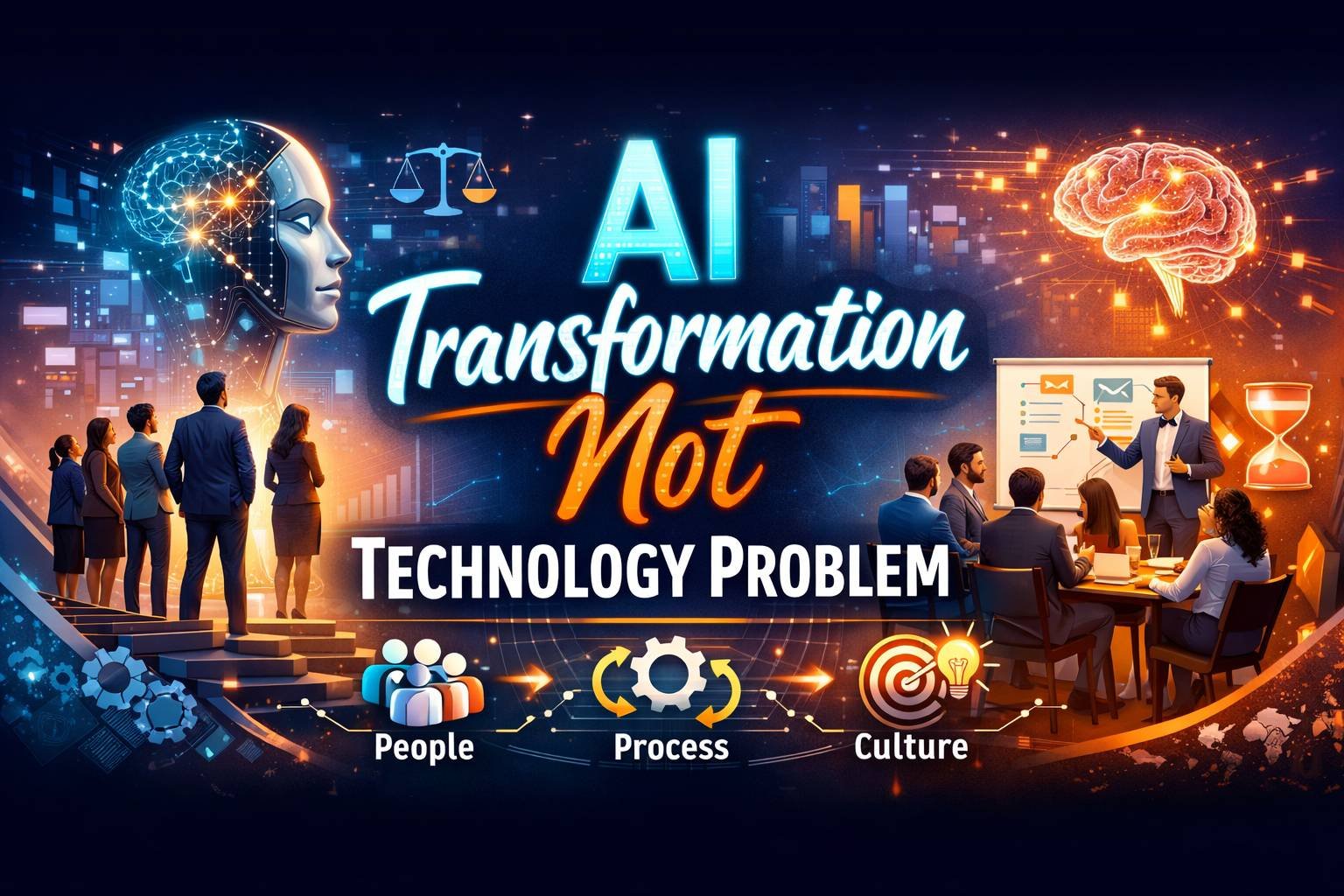
AI Transformation Not Technology Problem
AI transformation is often misunderstood. Many organizations assume that adopting artificial intelligence is mainly about selecting the right tools, models, or platforms. They focus heavily on software vendors, cloud infrastructure, and algorithms, believing that technical upgrades alone will unlock value. In reality, this mindset is the reason many AI initiatives fail.
AI transformation is not a technology problem. It is a leadership, culture, and operating model problem. Technology is only one component, and usually not the hardest one. The real challenge lies in how organizations think, decide, work, and adapt around AI.
This article explains why AI transformation is fundamentally a human and organizational issue, what typically goes wrong, and how companies can approach AI in a way that delivers lasting impact.
Understanding What AI Transformation Really Means
AI transformation is about changing how an organization creates value using intelligence at scale. It is not just about automating tasks or deploying predictive models.
At its core, AI transformation involves:
-
Rethinking decision-making processes
-
Redesigning workflows and roles
-
Changing how teams collaborate with machines
-
Shifting leadership assumptions about control, risk, and speed
Technology enables these changes, but it does not drive them. People and systems do.
Organizations that treat AI as a plug-and-play technology initiative often end up with isolated pilots, unused dashboards, and frustrated teams.
Why the “Technology-First” Mindset Fails
Many AI programs start with the wrong question. Leaders ask, “Which AI tools should we buy?” instead of “What decisions and processes should change?”
This leads to several predictable problems.
First, teams deploy AI without clear ownership. Models exist, but no one trusts them enough to use them in real decisions.
Second, AI outputs conflict with existing processes. Even accurate insights get ignored because they do not fit how work is currently done.
Third, employees resist AI quietly. They comply on the surface but continue using old methods behind the scenes.
None of these issues are technical failures. They are organizational failures.
AI Transformation Starts With Leadership, Not Software
Leadership behavior sets the ceiling for AI success. If leaders treat AI as an IT project, the organization will too.
Effective AI transformation requires leaders to:
-
Be explicit about where AI should influence decisions
-
Accept that AI may challenge intuition and hierarchy
-
Redefine accountability when humans and machines collaborate
-
Model curiosity instead of defensiveness when AI reveals uncomfortable truths
When leaders continue to reward gut instinct over data-backed insights, no model will ever matter. When leaders punish teams for experimentation failures, innovation stops immediately.
AI changes how power and expertise flow through an organization. Leadership must be willing to adapt.
Culture Is the Biggest Barrier to AI Adoption
Culture determines whether AI insights are embraced or ignored. Even the best systems fail in cultures that are not ready for them.
Common cultural barriers include:
-
Fear of job loss or role erosion
-
Distrust of “black box” decisions
-
Overconfidence in past experience
-
Siloed thinking that limits data sharing
AI thrives in environments where learning is continuous and mistakes are treated as feedback, not failure. In rigid cultures, AI becomes a threat instead of a tool.
Changing culture is difficult, but ignoring it guarantees failure.
AI Exposes Broken Processes Instead of Fixing Them
One of the most uncomfortable truths about AI is that it amplifies existing organizational weaknesses.
If a process is unclear, AI will not magically clarify it. If decision rights are ambiguous, AI will not resolve them. If data governance is weak, AI will expose it quickly.
This is why many AI projects stall after initial excitement. They reveal deeper structural problems that organizations are not prepared to confront.
Successful AI transformation treats these moments as opportunities, not setbacks. The goal is not to hide flaws but to redesign systems around them.
Data Problems Are Usually Ownership Problems
Organizations often claim their biggest AI challenge is “bad data.” While data quality matters, the real issue is usually unclear ownership.
Questions that often go unanswered include:
-
Who is responsible for data accuracy?
-
Who decides which data matters?
-
Who is accountable when AI-driven decisions go wrong?
Without clear answers, data remains fragmented and unreliable. Technical fixes alone cannot solve this.
Strong data ownership models, aligned with business goals, are essential for AI to function meaningfully.
Skills Gaps Are About Mindset, Not Just Training
AI transformation does require new skills, but not only technical ones. Many organizations overinvest in tools while underinvesting in capability building.
Critical non-technical skills include:
-
Data literacy across all roles
-
Critical thinking about AI outputs
-
Ethical judgment and contextual awareness
-
Collaboration between domain experts and technical teams
Training programs that focus only on how AI works miss the point. People need to understand how to work with AI, question it, and integrate it into decisions responsibly.
AI Changes How Decisions Are Made
Traditional decision-making often relies on experience, hierarchy, and consensus. AI introduces a different dynamic by offering probabilistic insights at speed.
This creates tension:
-
Should leaders override AI when it conflicts with intuition?
-
How much transparency is required to trust a model?
-
Who is accountable for AI-assisted decisions?
Organizations that do not address these questions explicitly end up in paralysis. Either AI is ignored, or it is followed blindly.
Mature AI organizations define clear decision frameworks that balance human judgment with machine insight.
Trust Is the Real Currency of AI Transformation
Trust determines whether AI is used or sidelined. This trust must exist at multiple levels.
Employees must trust that AI will not unfairly penalize them. Leaders must trust AI enough to let it influence strategy. Customers must trust that AI-driven outcomes are fair and transparent.
Trust is built through:
-
Explainability where it matters
-
Consistent performance over time
-
Clear communication about limitations
-
Ethical safeguards and oversight
Trust cannot be installed with software. It must be earned.
Ethics and Governance Are Organizational Responsibilities
AI ethics is often framed as a technical compliance issue. In reality, it is a governance and values issue.
Questions of bias, fairness, accountability, and transparency reflect organizational priorities. If leadership does not set clear ethical boundaries, technical teams are left guessing.
Effective AI governance includes:
-
Clear principles aligned with company values
-
Cross-functional oversight
-
Escalation paths for ethical concerns
-
Continuous review as systems evolve
Ethics is not a one-time checklist. It is an ongoing organizational commitment.
Scaling AI Requires Operating Model Changes
Many companies succeed in small AI pilots but fail to scale them. The reason is rarely technical.
Scaling AI requires changes in:
-
Budgeting and investment cycles
-
Performance metrics and incentives
-
Team structures and collaboration models
-
Procurement and vendor management
AI moves faster than traditional corporate rhythms. Organizations that cannot adapt their operating models struggle to keep up, regardless of technical capability.
AI Transformation Is a Long-Term Journey
AI transformation is not a project with a fixed end date. It is an ongoing evolution in how work gets done.
Organizations that expect quick wins without structural change become disillusioned. Those that treat AI as a long-term capability invest differently.
This includes:
-
Continuous learning programs
-
Iterative improvement of models and processes
-
Regular reassessment of ethical implications
-
Willingness to retire systems that no longer serve goals
Patience and persistence matter more than speed.
Why People, Process, and Purpose Come First
Technology should support strategy, not define it. AI transformation works best when organizations start with purpose.
Key questions to ask include:
-
What decisions matter most to our success?
-
Where does uncertainty slow us down?
-
How can AI augment human strengths instead of replacing them?
-
What values must guide our use of AI?
When these questions are answered first, technology choices become clearer and more effective.
Common Myths About AI Transformation
Several myths continue to mislead organizations.
One myth is that more data automatically means better AI. Without relevance and governance, more data often creates more noise.
Another myth is that AI will reduce complexity. In reality, AI often introduces new layers of complexity that must be managed intentionally.
A third myth is that resistance means people are “anti-technology.” Most resistance is actually rational concern about impact, fairness, and control.
Dispelling these myths is critical for progress.
What Successful AI-Driven Organizations Do Differently
Organizations that succeed with AI share common traits.
They align AI initiatives with clear business outcomes. They involve end users early instead of imposing solutions. They invest in communication as much as computation.
Most importantly, they accept that AI will change how power, expertise, and accountability are distributed. They manage this change proactively rather than reactively.
Success is not about having the most advanced models. It is about having the most adaptive organization.
Measuring AI Success Beyond ROI
Return on investment matters, but it is not the only metric that counts.
Other important indicators include:
-
Adoption rates of AI-supported tools
-
Decision cycle time improvements
-
Employee confidence in AI outputs
-
Reduction in bias or inconsistency
-
Ability to respond faster to change
These metrics reflect organizational maturity, not just technical performance.
The Future of AI Belongs to Adaptive Organizations
As AI technologies continue to evolve, the gap between leaders and laggards will widen. The difference will not be access to technology, but the ability to adapt.
Organizations that build flexible cultures, empowered teams, and ethical foundations will continue to extract value from AI. Those that treat AI as a one-off technology upgrade will struggle.
The future belongs to organizations that see AI as a catalyst for transformation, not a shortcut.
Final Thoughts: Reframing the AI Conversation
AI transformation is not a technology problem. Technology is the easy part.
The real work happens in boardrooms, team meetings, performance reviews, and daily decisions. It happens when leaders choose learning over certainty, transparency over control, and adaptability over comfort.
When organizations reframe AI as an organizational transformation rather than a technical deployment, they unlock its true potential. Only then does AI move from experimentation to impact.
In the end, AI does not transform organizations. People do.