

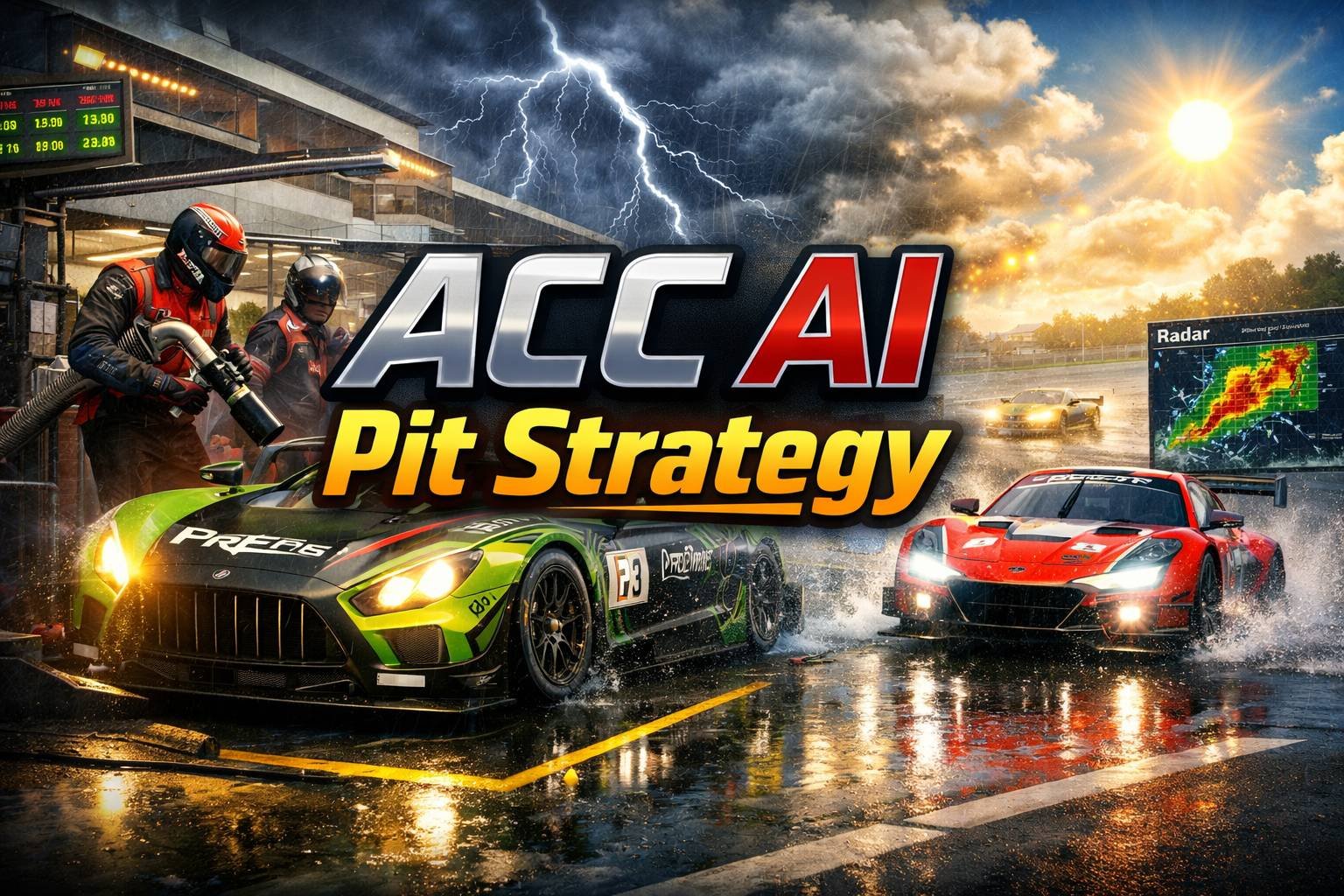
ACC AI Pit Strategy
Assetto Corsa Competizione, commonly known as ACC, is one of the most realistic GT racing simulators available today. While many players focus on car setups, driving technique, and track knowledge, one of the most misunderstood yet critical aspects of success is the ACC AI pit strategy. Whether you race against AI in single-player championships, endurance events, or custom races, understanding how the AI handles pit stops and how you can outsmart it is essential for consistent victories.
This guide dives deep into how the ACC AI pit strategy works, how fuel, tires, weather, and race length influence AI decisions, and how you can plan smarter pit strategies to gain positions without pushing harder on track.
Understanding AI Behavior in Assetto Corsa Competizione
The AI in ACC is designed to mimic real GT World Challenge teams. Unlike arcade racing games, the AI does not pit randomly. Its decisions are influenced by race duration, mandatory pit rules, tire wear models, fuel calculations, weather forecasts, and difficulty settings.
AI drivers follow predefined strategy logic rather than reacting dynamically like human players. This predictability can be exploited if you understand the system properly. In longer races, especially endurance events, strategy becomes more important than outright lap speed.
How ACC AI Pit Strategy Works
Fixed Strategic Logic
The ACC AI pit strategy operates on a calculated model rather than improvisation. Before the race even begins, the AI determines how many pit stops it will need based on race length and fuel capacity. During the race, it follows this plan unless weather conditions force a change.
This means the AI will often pit at similar times each race, which allows players to plan alternative strategies such as undercutting or overcutting.
Mandatory Pit Stops
In races with mandatory pit stops, the AI strictly follows the rule set. If a tire change or driver swap is required, the AI ensures compliance even if it costs time. This makes the AI reliable but also predictable.
Human players can sometimes gain time by minimizing stationary pit time while still following regulations.
Fuel Strategy and AI Decision Making
Fuel management is the backbone of the ACC AI pit strategy. AI cars always aim to finish a stint with a small fuel buffer rather than risk running out.
Fuel Calculation Accuracy
AI fuel calculations are conservative. They usually add extra liters to ensure they never run dry. This means AI pit stops are often slightly longer than necessary, giving players an opportunity to gain track position by running tighter fuel margins.
Single Stop vs Multiple Stop Races
In sprint races of 20 to 30 minutes, the AI typically avoids refueling entirely unless mandatory pit rules apply. In endurance races, the AI splits fuel evenly across stints, rarely attempting aggressive short fills.
If you manually calculate fuel based on your driving style, you can often pit later or earlier than the AI and gain time through clean air.
Tire Strategy and Degradation
AI Tire Wear Model
The AI experiences tire degradation similarly to players, but with a few key differences. AI tire wear is more stable and less affected by aggressive driving. This allows AI cars to maintain consistent lap times deeper into a stint.
However, the AI almost always changes tires during pit stops in races longer than 30 minutes, even when tire wear might allow another stint.
Exploiting Tire Strategy
Players can exploit this by double-stinting tires in endurance races, especially on tracks with low tire degradation such as Monza or Paul Ricard. While the AI wastes time changing tires, you stay on track and gain position.
Weather Impact on ACC AI Pit Strategy
Weather plays a massive role in ACC pit strategy, especially in races with dynamic conditions.
AI Response to Rain
The AI reacts instantly to rain thresholds. As soon as the track condition reaches the crossover point, AI cars pit for wet tires. This reaction is sometimes too early or too late, depending on how fast the rain develops.
Human players who read the weather radar carefully can delay or advance tire changes to gain huge advantages.
Drying Track Scenarios
In drying conditions, the AI often waits too long to switch back to slicks. This is one of the biggest weaknesses in the ACC AI pit strategy. Players who switch early when the racing line dries can gain multiple seconds per lap.
Pit Window Timing and Strategy
AI Pit Windows
The AI usually pits at the midpoint of the allowed pit window. This behavior rarely changes unless forced by weather or fuel constraints. Knowing this allows players to plan undercuts or overcuts effectively.
Undercut Strategy
By pitting earlier than the AI and running faster laps on fresh tires, players can jump AI cars when they pit later. This is especially effective on tracks with high tire degradation.
Overcut Strategy
Overcutting works well when tire wear is low or when the AI pits early. Staying out longer while the AI is stuck in traffic after their pit stop can gain you track position.
Difficulty Level and AI Strategy Differences
Low Difficulty AI
At lower difficulty settings, the AI follows very conservative strategies. Pit stops are earlier, fuel margins are larger, and tire changes are more frequent. This makes it easier to beat the AI through smarter planning.
High Difficulty AI
At higher difficulty levels, AI pit strategies become more optimized but still predictable. Fuel margins tighten slightly, and pit stop timing becomes more consistent with real-world GT racing.
Even at the highest difficulty, AI strategy logic does not adapt dynamically to player actions.
Endurance Racing and AI Pit Strategy
Endurance races showcase the strengths and weaknesses of the ACC AI pit strategy more clearly than sprint events.
Driver Swaps
In races with driver swap requirements, the AI always swaps at the minimum allowed time. This can sometimes be inefficient, especially if traffic is heavy. Players can choose safer windows to avoid losing time.
Night and Temperature Changes
The AI does not adapt tire pressures perfectly to temperature changes. During night stints, players who manually adjust tire pressures can gain consistent lap time advantages.
Common AI Pit Strategy Mistakes You Can Exploit
The ACC AI pit strategy is realistic but far from perfect. Some recurring mistakes include:
- Pitting too early for rain
- Changing tires unnecessarily
- Overfueling every stint
- Ignoring traffic when exiting pits
- Poor timing on drying tracks
By staying flexible and reacting to live conditions, players can consistently out-strategize the AI.
Best Player Pit Strategy to Beat AI Consistently
Plan Before the Race
Before starting any race, calculate fuel requirements, understand mandatory pit rules, and check weather forecasts. A clear plan prevents panic decisions mid-race.
Adapt During the Race
Unlike the AI, players can adapt. Watch lap times, track grip, and weather radar. Make decisions based on real conditions rather than fixed rules.
Practice Pit Execution
Fast pit entries and exits matter. AI pit execution is perfect but not aggressive. Players who practice pit lane speed control and stopping accuracy can save valuable seconds.
Custom Race Settings and AI Strategy Behavior
Custom race settings influence AI pit behavior significantly.
- Higher fuel consumption increases pit frequency
- Accelerated time affects weather changes
- Mandatory pit rules enforce tire changes
- Track grip level impacts tire wear
Understanding how these settings interact with AI strategy allows players to tailor races for realism or challenge.
Single Player Championships and Career Mode Strategy
In championships, AI pit strategies remain consistent across races. This allows long-term planning. Saving tires, minimizing damage, and avoiding penalties gives cumulative advantages over AI competitors.
Career mode races often include fixed pit rules, making strategy execution even more important than raw speed.
Advanced Tips for ACC AI Pit Strategy Mastery
- Use live timing to predict AI pit laps
- Watch AI fuel burn during practice
- Practice wet to dry transitions
- Learn track specific tire wear behavior
- Test strategies in practice sessions
Small strategic improvements add up over long races.
Why Pit Strategy Matters More Than Lap Time
Many players try to beat AI by driving faster, but strategy often matters more. A slower driver with a smarter pit strategy can beat faster AI cars over race distance.
ACC rewards intelligent decision making just as much as driving skill.
Final Thoughts on ACC AI Pit Strategy
The ACC AI pit strategy is designed to be realistic, consistent, and rule compliant. While it lacks the adaptability of human decision making, it creates a solid foundation for competitive racing.
By understanding AI behavior, fuel logic, tire choices, and weather responses, players can consistently gain positions without unnecessary risk. Mastering pit strategy transforms ACC from a driving simulator into a full motorsport experience.
If you want to win races, championships, and endurance events in Assetto Corsa Competizione, learning how to outthink the AI in the pits is just as important as mastering braking points on track.