

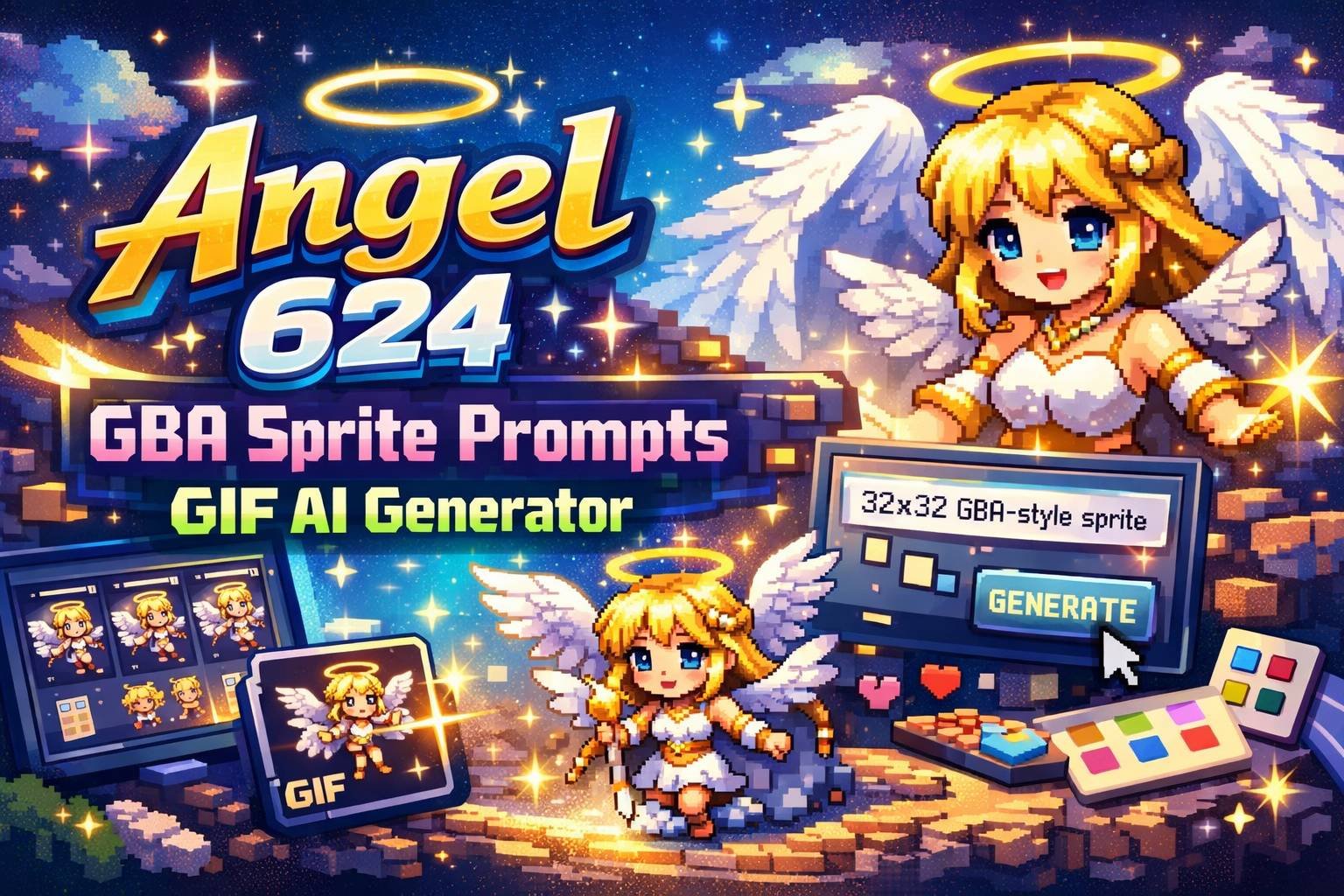
The concept of Angel 624 GBA Sprite Prompts GIF AI Generator blends retro game aesthetics with modern artificial intelligence workflows. It focuses on creating angel themed Game Boy Advance style sprites that are often inspired by numbered character concepts like 624 and animating them into GIFs using carefully crafted AI prompts. This approach appeals to indie developers pixel artists ROM hackers and content creators who want nostalgic visuals without spending months on manual pixel work.
GBA sprites are famous for their charm, limitations, and expressive design. By combining those constraints with AI generation, creators can quickly prototype characters, test animations, and iterate on ideas that once required advanced pixel-art skills. Angel-themed sprites, in particular, benefit from AI because of their complex elements like wings, halos, light effects, and flowing garments.
This guide explores how Angel 624 GBA Sprite Prompts GIF AI Generator workflows operate, how to design effective prompts, how GIF animation fits into the process, and how to maintain authenticity with classic GBA visuals while using modern tools responsibly.
Understanding GBA Sprite Style Fundamentals
Before using any AI generator, it’s critical to understand what defines a true GBA-style sprite.
Game Boy Advance sprites typically follow strict technical and artistic rules. They usually fit within sizes like 16×16, 32×32, or 64×64 pixels. Color palettes are limited, often capped at 16 or 32 colors per sprite, including transparency. Shading is done manually with high contrast to make characters readable on small screens.
When generating Angel 624 sprites, these fundamentals guide the AI output. Without them, the results may look like generic pixel art rather than authentic GBA sprites.
Key GBA sprite characteristics include:
-
Strong outlines or silhouette clarity
-
Limited color gradients
-
Exaggerated facial and body features for readability
-
Minimal anti-aliasing
-
Clear pose definition
Understanding these constraints helps you write better prompts and evaluate AI-generated results accurately.
What “Angel 624” Represents in Sprite Design
“Angel 624” is best understood as a conceptual character label rather than a fixed canon design. Many creators use numbered angels or experimental character IDs to explore variations in personality, attire, and powers without being locked into existing franchises.
In sprite prompts, Angel 624 often represents:
-
A celestial or divine character archetype
-
A unique identity distinguished by wings, symbols, or color themes
-
A test subject for variations in pose, emotion, and animation
This abstraction makes Angel 624 ideal for AI generation. You can experiment freely with armor styles, wing shapes, light effects, and expressions without worrying about strict lore accuracy.
Role of AI in GBA Sprite Creation
AI generators act as accelerators rather than replacements for artistic judgment. In the context of Angel 624 GBA Sprite Prompts GIF AI Generator workflows, AI is used to:
-
Generate base sprite concepts
-
Explore pose and costume variations
-
Assist with animation frame ideas
-
Speed up ideation and prototyping
However, AI does not automatically understand GBA hardware limits unless you instruct it clearly. Prompt quality directly affects whether the output feels retro-authentic or modernized pixel art.
The strongest workflows combine AI generation with human review, cleanup, and refinement. Artists often retouch frames manually or adjust palettes after AI generation to maintain consistency.
Writing Effective Angel 624 GBA Sprite Prompts
Prompt writing is the foundation of any successful AI sprite generator workflow. A vague prompt produces inconsistent results, while a structured prompt leads to repeatable, usable sprites.
An effective Angel 624 GBA sprite prompt typically includes:
-
Art style reference
-
Sprite size or resolution
-
Color limitations
-
Character attributes
-
Pose or animation state
Instead of asking for “an angel sprite,” specify “a 32×32 GBA-style pixel sprite of Angel 624 with folded white wings, gold halo, limited 16-color palette, front-facing idle pose.”
Prompt clarity reduces hallucinated details and keeps the AI aligned with GBA aesthetics.
Structuring Prompts for Consistent Results
Consistency is essential when generating multiple frames for GIF animation. Prompts should be modular and repeatable.
A common structure looks like:
-
Style definition
-
Character identity
-
Pose or motion
-
Technical constraints
For example, you may reuse the same base prompt for Angel 624 and only change the pose description when generating attack, idle, or flight frames.
This approach helps maintain consistent proportions, colors, and facial features across frames.
Creating Angel-Themed Visual Elements with AI
Angel sprites are more complex than standard humanoid characters. Wings, halos, and glowing effects introduce visual noise if not handled carefully.
AI prompts should describe wings clearly:
-
Feather count suggestion
-
Wing position (folded, spread, mid-flap)
-
Light source direction
For halos, it’s important to specify:
-
Thin or thick outline
-
Floating distance above the head
-
Single-color glow instead of gradients
These constraints prevent AI from producing overly detailed effects that clash with GBA limitations.
GIF Animation in GBA Sprite Workflows
GIFs play a crucial role in visualizing sprite animations. While the original GBA hardware doesn’t use GIFs, creators rely on them to preview animations in browsers and engines.
In Angel 624 GBA Sprite Prompts GIF AI Generator workflows, GIFs are typically used for:
-
Idle loops
-
Wing flapping cycles
-
Attack animations
-
Hover or flight effects
Each frame must align perfectly in size and position. Even slight inconsistencies can cause jitter in the final animation.
Designing Animation Frames with AI Prompts
When generating frames with AI, it’s best to request one frame at a time rather than a full animation in a single prompt. This allows better control and cleaner results.
Frame-specific prompt adjustments might include:
-
“idle frame, wings slightly raised”
-
“mid-flap frame, wings extended”
-
“downstroke frame, wings angled downward”
After generating frames, creators often assemble them manually into a GIF using animation tools to ensure smooth looping.
Maintaining Palette Consistency Across Frames
One of the biggest challenges with AI-generated sprites is color drift. Each generation may introduce slightly different shades, which breaks animation cohesion.
To avoid this:
-
Specify a fixed palette in the prompt
-
Mention “consistent colors across frames”
-
Manually recolor sprites after generation
Some creators extract a palette from the first frame and apply it to subsequent frames using pixel-editing software.
Palette discipline is essential for maintaining true GBA authenticity.
Avoiding Common AI Sprite Generation Mistakes
AI generators are powerful, but they make predictable mistakes if prompts are weak.
Common issues include:
-
Over-shaded sprites with too many colors
-
Blurry pixel edges
-
Incorrect proportions between frames
-
Modern lighting effects that don’t fit GBA style
These problems are usually solved by tightening prompt constraints and performing manual cleanup rather than regenerating endlessly.
Ethical and Legal Considerations
Angel 624 GBA Sprite Prompts GIF AI Generator workflows must respect intellectual property boundaries. While angel archetypes are generally safe, referencing specific copyrighted characters or franchises can create legal issues.
Best practices include:
-
Using original character names
-
Avoiding direct references to existing game characters
-
Treating AI outputs as inspiration, not replicas
This approach protects creators and ensures their sprites can be used commercially or publicly without complications.
Integrating AI-Generated Sprites into Games
Once sprites are finalized, they can be integrated into:
-
Indie games
-
ROM hacks
-
Visual novels
-
Pixel-art demos
Developers usually convert AI-generated sprites into sprite sheets compatible with their engine. Animation timing, hitboxes, and state transitions are then added manually.
AI speeds up asset creation, but final implementation still requires traditional game development skills.
Using Angel 624 Sprites for Content and Media
Beyond games, Angel 624 sprites are popular in:
-
Social media GIFs
-
Blog illustrations
-
YouTube overlays
-
Concept art showcases
GIF animations perform especially well as featured visuals because they demonstrate motion and personality in a compact format.
This makes AI-generated sprites valuable not only for developers but also for digital marketers and content creators.
Improving Results Through Iteration
The best AI sprite results rarely come from a single prompt. Iteration is part of the process.
Effective iteration strategies include:
-
Refining one detail at a time
-
Locking successful prompt sections
-
Comparing multiple outputs side by side
By treating AI as a collaborative tool, creators gradually shape Angel 624 into a consistent, polished character.
Future of AI in Retro Sprite Creation
As AI models improve, sprite generation will become more controllable and precise. Future tools may allow:
-
Direct palette locking
-
Frame-to-frame consistency modeling
-
Native sprite sheet exports
Despite this progress, understanding retro design principles will remain essential. AI can assist, but it cannot replace artistic judgment or knowledge of hardware limitations.
Best Practices Summary
To succeed with Angel 624 GBA Sprite Prompts GIF AI Generator workflows:
-
Study authentic GBA sprite rules
-
Write structured, constraint-driven prompts
-
Generate frames individually
-
Enforce palette consistency
-
Clean up results manually
-
Respect originality and IP boundaries
Following these practices ensures AI-generated sprites feel intentional, professional, and true to retro gaming aesthetics.
Final Thoughts
Angel 624 GBA Sprite Prompts GIF AI Generator workflows represent a powerful fusion of nostalgia and innovation. They allow creators to explore angelic character designs, experiment with animation, and bring retro-inspired visuals to life faster than ever before.
When used thoughtfully, AI becomes an extension of the artist’s imagination rather than a shortcut. By respecting GBA constraints, refining prompts carefully, and maintaining creative control, creators can produce sprites that feel both timeless and modern while bridging the gap between classic pixel art and the future of game design.