

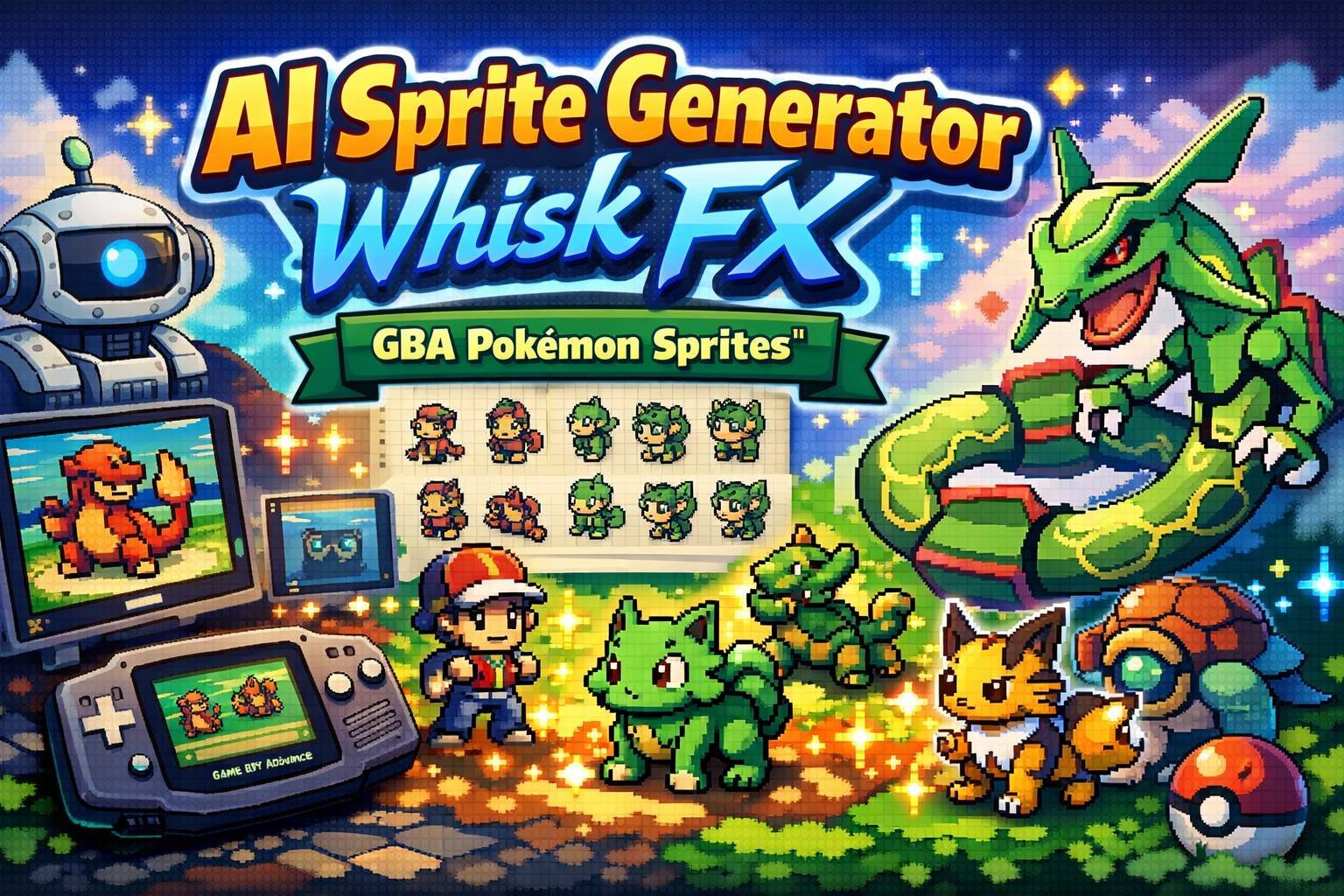
AI sprite generator Whisk FX GBA Pokémon sprite creation has become increasingly popular among developers and pixel artists working on retro-style games. Many creators want the classic Game Boy Advance Pokémon look but need faster ways to design consistent, high-quality sprites without spending countless hours placing individual pixels.
GBA Pokémon sprites are known for their limited color palettes, sharp outlines, and expressive designs that work within strict technical limits. Recreating that style manually requires strong pixel art skills and deep knowledge of sprite constraints, which can slow down small teams and solo developers.
This page explores how AI sprite generators combined with Whisk FX-style processing help produce Pokémon-inspired GBA sprites. It breaks down how these tools work, what makes GBA sprites unique, and how modern workflows blend automation with manual refinement.
Understanding GBA Pokémon Sprites
What Defines a GBA Pokémon Sprite
Game Boy Advance Pokémon sprites follow very specific design rules. These constraints are critical for any ai sprite generator whisk fx gba pokemon sprite workflow to succeed.
Key characteristics include:
-
Sprite size: Commonly 32×32 or 64×64 pixels
-
Limited color palettes: Typically 16 colors per sprite
-
High contrast outlines: Dark borders to define form
-
Directional lighting: Usually top-left light source
-
Exaggerated silhouettes: Clear shape readability
These rules ensured sprites were readable on low-resolution screens while still feeling lively and detailed.
Battle Sprites vs Overworld Sprites
GBA Pokémon games use multiple sprite types:
-
Battle sprites
-
Larger size
-
More shading detail
-
Dynamic poses
-
-
Overworld sprites
-
Smaller (often 16×16 or 32×32)
-
Simplified shapes
-
Designed for grid-based movement
-
An effective ai sprite generator whisk fx gba pokemon sprite system must understand these differences or allow the user to define them clearly.
What Is an AI Sprite Generator?
Core Concept of AI Sprite Generation
An AI sprite generator uses machine learning models to produce pixel art sprites based on inputs such as:
-
Text prompts
-
Reference images
-
Style constraints
-
Resolution and palette rules
Instead of manually placing pixels, the AI predicts pixel placement based on patterns learned from existing sprite datasets.
In the context of gba pokemon sprite creation, the AI must learn:
-
Pixel clustering
-
Outline conventions
-
Shading logic
-
Proportional exaggeration
How AI Handles Pixel Art Differently
Pixel art is uniquely challenging for AI because:
-
Each pixel matters
-
Blurring ruins clarity
-
Anti-aliasing must be intentional
-
Color count must be controlled
Advanced sprite generators avoid traditional image smoothing and instead generate hard-edged, grid-aligned pixel output.
This is essential for maintaining authenticity in Pokémon-style sprites.
Whisk FX Explained in the Sprite Workflow
What “Whisk FX” Typically Represents
While “Whisk FX” is not a single standardized engine, the term is commonly used to describe stylized post-processing effects applied to AI-generated images.
In sprite generation, Whisk FX can refer to:
-
Sharpening pixel edges
-
Enhancing outlines
-
Adding controlled contrast
-
Cleaning noisy pixel clusters
When paired with an ai sprite generator, Whisk FX techniques help refine raw AI output into game-ready sprites.
Why FX Processing Matters for GBA Sprites
AI-generated sprites often require refinement:
-
Random pixels (“noise”) appear
-
Colors exceed palette limits
-
Outlines may be inconsistent
Whisk FX-style processing solves these issues by:
-
Enforcing palette constraints
-
Tightening outlines
-
Normalizing shading patterns
This step is critical for transforming AI art into authentic gba pokemon sprite assets.
How AI Learns Pokémon-Style Sprites
Training Data and Style Learning
For an ai sprite generator whisk fx gba pokemon sprite system to work well, the training data matters more than the model size.
Effective datasets include:
-
Original GBA Pokémon sprites
-
Fan-made Pokémon-style sprites
-
Retro RPG monster sprites
-
Pixel art character sheets
The AI learns repeating structures such as:
-
Eye placement
-
Limb proportions
-
Common shading angles
Style Tokens and Prompt Conditioning
Modern AI generators use style tokens or weighted prompts such as:
-
“GBA Pokémon style”
-
“16-color pixel art”
-
“Game Boy Advance sprite shading”
-
“Retro RPG monster”
These tokens help the AI lock into a specific visual language rather than generating generic pixel art.
Prompt Engineering for Pokémon Sprite Generation
Writing Effective Sprite Prompts
Prompt design is essential when working with an AI sprite generator.
A strong prompt example:
“32×32 pixel art creature in gba pokemon sprite style, limited 16 color palette, thick dark outline, top-left lighting, battle-ready pose”
This prompt clearly defines:
-
Resolution
-
Style
-
Palette
-
Lighting
-
Purpose
Avoiding Common Prompt Mistakes
Weak prompts cause poor output. Avoid:
-
Vague terms like “cute pixel monster”
-
Missing resolution details
-
No palette limits
-
No outline instructions
Precision is the difference between usable sprites and unusable noise.
Sprite Sheet Generation and Animation
Creating Multi-Frame Pokémon Sprites
Many developers want animated sprites:
-
Idle animations
-
Attack frames
-
Damage reactions
Advanced AI workflows generate:
-
Frame-by-frame sprites
-
Consistent proportions across frames
-
Stable color palettes
Whisk FX post-processing helps maintain consistency between frames.
Aligning Sprites for Game Engines
Sprites must align to grids for GBA-style engines.
Key alignment rules:
-
Consistent anchor points
-
Uniform canvas sizes
-
Transparent backgrounds
AI-generated sprites often need manual alignment checks before use in production.
Legal and Ethical Considerations
Pokémon-Inspired vs Pokémon-Copied
This is critical.
-
Inspired: Legal, safe, original
-
Copied: Copyright risk
An ai sprite generator whisk fx gba pokemon sprite workflow should create original creatures, not replicas of existing Pokémon.
Change:
-
Shapes
-
Color combinations
-
Facial structures
Never reproduce copyrighted characters pixel-for-pixel.
Responsible Dataset Usage
Using copyrighted sprites directly in training can raise issues.
Best practice includes:
-
Using fan-made sprites with permission
-
Training on style abstraction
-
Avoiding exact sprite duplication
This keeps projects legally and ethically safe.
Use Cases for AI-Generated GBA Pokémon Sprites
Indie Game Development
AI sprite generators help small teams:
-
Reduce production time
-
Create placeholder art quickly
-
Explore creature designs rapidly
They are especially valuable during prototyping.
Fan Projects and ROM Hacks
Many Pokémon fans create:
-
Custom regions
-
Fakémon
-
Story mods
AI tools accelerate ideation while allowing artists to refine final sprites manually.
Education and Learning Pixel Art
Studying AI output helps beginners:
-
Understand shading patterns
-
Learn silhouette design
-
Analyze palette efficiency
AI becomes a learning assistant rather than a replacement.
Limitations of AI Sprite Generators
Where AI Still Struggles
Despite advances, AI is not perfect.
Common issues include:
-
Inconsistent outlines
-
Awkward anatomy
-
Over-shading
-
Repeating visual motifs
Human oversight remains essential.
Why Manual Editing Is Still Important
Professional-quality sprites often require:
-
Pixel cleanup
-
Outline correction
-
Palette optimization
-
Animation smoothing
The best results come from AI + human refinement, not AI alone.
Future of AI in Retro Sprite Design
Improving Consistency and Control
Future tools will likely include:
-
Locked palette systems
-
Style sliders
-
Pose control
-
Animation-aware generation
These features will dramatically improve reliability.
AI as a Creative Partner
Rather than replacing artists, AI sprite generators act as:
-
Idea accelerators
-
Style exploration tools
-
Production assistants
For GBA Pokémon-style art, this partnership is especially powerful.
Best Practices for Using AI Sprite Generators
Practical Workflow Summary
A strong workflow looks like this:
-
Define sprite requirements
-
Write precise prompts
-
Generate multiple variations
-
Apply Whisk FX-style cleanup
-
Manually refine pixels
-
Test sprites in-engine
This process balances speed and quality.
Quality Control Checklist
Before finalizing a sprite:
-
Check palette limits
-
Verify silhouette clarity
-
Inspect outlines
-
Ensure grid alignment
These steps prevent visual issues later.
Conclusion
The keyword ai sprite generator whisk fx gba pokemon sprite captures a modern creative movement built on nostalgia, technology, and efficiency. AI tools now make it possible to explore Pokémon-style sprite design faster than ever, while Whisk FX-style processing ensures visual polish and authenticity.
However, success depends on understanding the fundamentals of GBA sprite design, writing precise prompts, and respecting legal boundaries. AI is not a shortcut to perfection; it is a powerful assistant that amplifies human creativity.
When used responsibly and skillfully, AI sprite generators open new doors for indie developers, artists, and retro game enthusiasts who want to bring Pokémon-inspired worlds to life, one pixel at a time.